

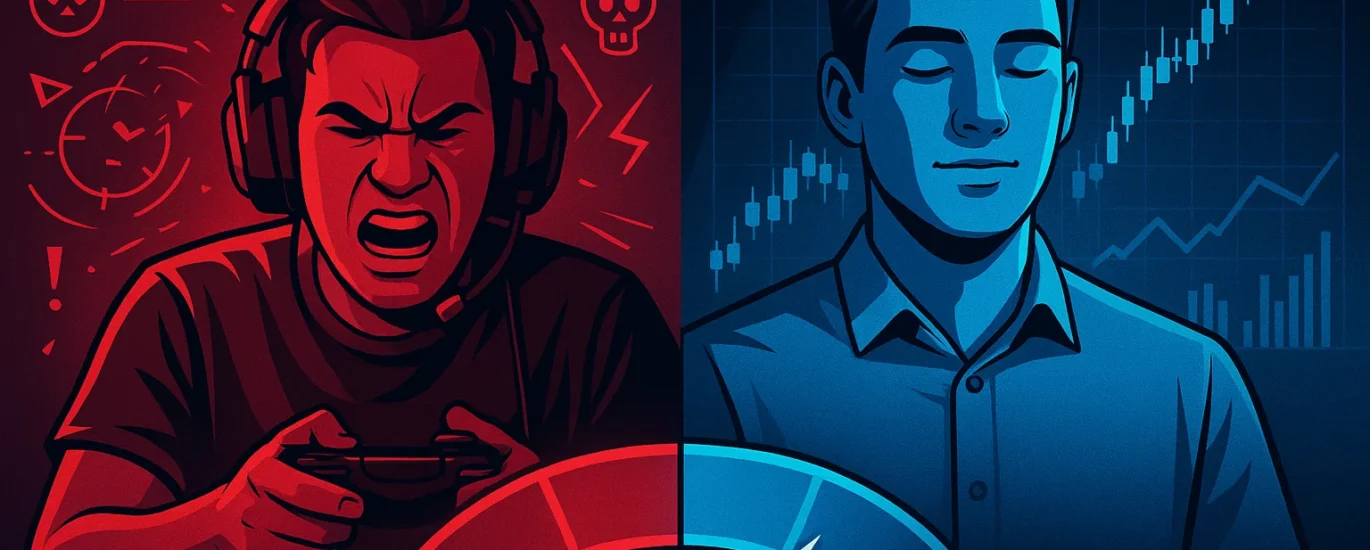
In competitive gaming, “tilt” is a state of mental and emotional confusion or frustration in which a player adopts a suboptimal strategy, usually resulting in the player becoming overly aggressive. It happens after a bad beat, a teammate’s mistake, or a string of losses.
The player stops thinking and starts reacting to pure emotion. In the world of trading, tilt is not just annoying but financially fatal. The psychology that causes a gamer to smash their keyboard is the exact same psychology that causes a trader to blow up their account. Understanding the mechanics of tilt is the first step to conquering it.
The Dopamine Crash
Tilt is often a neurochemical event. When we are winning, our brain releases dopamine. When we lose, especially in a way that feels unfair (a lag spike in a game, a stop-hunt in trading), our dopamine levels crash, and cortisol (stress hormone) spikes. This creates a “fight or flight” response. The “fight” response in trading manifests as “revenge trading”—instantly opening a new, larger position to try and win back the money. The rational prefrontal cortex shuts down, and the emotional amygdala takes over. You are literally not in your right mind.
The “Walking Away” Protocol
Pro gamers have protocols for dealing with tilt. They call a timeout. They take their hands off the keyboard. They reset. Traders need a similar “circuit breaker.”
- The Rule of Three: If you lose three trades in a row, you are done for the day. Close the platform. Walk away.
- The Physical Reset: Change your physiology. Do pushups, splash cold water on your face, or go outside. You need to break the chemical feedback loop of cortisol.
Accepting the RNG (Random Number Generator)
In games like Hearthstone or Poker, you can make the perfect play and still lose due to RNG (luck). Good players accept this variance. Bad players tilt because of it. Trading is a game of probabilities, not certainties. A losing trade does not mean you made a mistake; it just means your probability didn’t hit this time. Separating the outcome from the process is the hallmark of a professional. If you followed your plan and lost, that is a “good loss.”
The Long Game
Tilt comes from a short-term focus: wanting to win this round, this trade. But the game is played over thousands of rounds. One loss is statistically insignificant unless you let it trigger a tilt spiral that wipes out your bankroll. This resilience is the core of Trading Psychology and Risk Management. To support this discipline, a trader needs a platform that doesn’t encourage gamification or impulsive clicking.
A professional environment like the YWO trading platform provides the tools for analysis and varied account types that encourage a measured, strategic approach, helping gamers-turned-traders keep their cool when the heat is on.